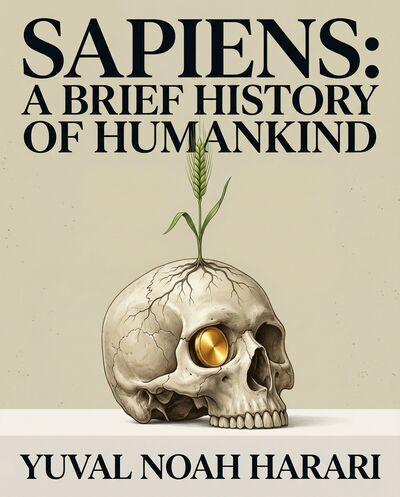
Sapiens: A Brief History of Humankind
by Yuval Noah Harari
Explores how humans conquered the planet not through physical strength but by creating shared myths and stories that enable massive cooperation. Reveals why our modern systems exist only because we collectively believe in them, from money to nations to religions.
Key Ideas
Humanity's unique advantage is the ability
Humanity's unique advantage is the ability to cooperate flexibly in large numbers by believing in shared fictions like nations, corporations, and human rights.
Farming led to more food and more people
Farming led to more food and more people, but resulted in harder work, worse health, and more social inequality than the hunter-gatherer lifestyle it replaced.
Money is the most successful and
Money is the most successful and tolerant system of mutual trust ever created, transcending every religious and cultural barrier in history.
Modern science began with the admission
Modern science began with the admission of ignorance, which allowed for a feedback loop where research produces power and power funds further research.
Human power has grown exponentially, but
Human power has grown exponentially, but because happiness is tied to biological set-points and rising expectations, individual well-being has likely stagnated.
Summary
Why it matters: Uncover the shared fictions that built our world
Humans dominate the planet not because of physical strength or superior tools, but because we can cooperate in massive numbers through shared beliefs. While other animals live in objective reality, humans inhabit a dual world - the physical realm plus an imagined realm of stories, myths, and fictions. This ability to collectively believe in the same concepts (nations, gods, money, laws) allows millions of strangers to trust and work together effectively.
The Cognitive Revolution was the key breakthrough that separated Sapiens from other species. Unlike a chimpanzee who only recognizes tangible rewards, humans can be motivated by abstract promises and shared narratives. The systems we often view as permanent fixtures - economies, legal frameworks, governments - only exist because we collectively agree they do. Human history is essentially a series of "imagined orders" built on these shared fictions rather than biological evolution, and recognizing this helps explain both our unprecedented success as a species and why we sometimes feel disconnected from meaning in modern life.
Humanity's dominance relies on the ability to create and believe in shared imagined realities.
Humans dominate the planet not through individual strength, but through our unique ability to cooperate in massive numbers by believing in shared "imagined realities." While a single chimp would easily overpower a human, a thousand humans would crush a thousand chimps because we can coordinate toward common goals while other species cannot organize beyond small groups of 50-60 individuals.
Our superpower lies in discussing and believing in things that don't physically exist—what the author calls "inter-subjective reality." Money, corporations like Peugeot, human rights, and nations are all "legal fictions" that exist only because millions of people agree to believe in them together. These shared myths serve as invisible threads connecting billions of strangers, enabling us to build civilizations, manage global markets, and cooperate on an unprecedented scale. However, this mythical foundation that allowed us to transcend tribal limitations would soon lead humanity into a "trap" that promised abundance but delivered a much more difficult existence.
The Agricultural Revolution was a clever trap that increased population at the cost of happiness.
The Agricultural Revolution is often seen as humanity's great leap forward, but it was actually a "luxury trap" that made individual lives worse while increasing population. Hunter-gatherers enjoyed diverse diets, flexible schedules, and mobility, spending mornings foraging and afternoons lounging by streams. When humans began farming, they traded this freedom for backbreaking labor, monotonous diets of grain porridge, and permanent settlements that caused new physical ailments like hernias and arthritis.
This shift happened gradually through small improvements that seemed beneficial—clearing fields, storing grain, building fences—but each step increased population and made returning to foraging impossible without mass starvation. From wheat's perspective, it successfully manipulated humans into spreading its DNA across millions of square kilometers. Evolution favored this change not because it improved human happiness, but because it increased the raw number of humans surviving, regardless of their quality of life.
The pattern continues today with "time-saving" technologies like email that end up making us busier and more enslaved to our tools. Humans and domesticated animals now comprise over 90% of large animal biomass on Earth, while wild animals represent less than 10%. We conquered the planet by creating a system that treats living beings as cogs in a machine, successfully filling the world with ourselves while the average farmer worked harder and ate worse than their foraging ancestors.
Money acts as the most successful and tolerant system of mutual trust ever invented.
Money emerged as humanity's most powerful unifying force, built entirely on shared belief rather than physical reality. The first known human name in history belongs to Kushim, an accountant in ancient Sumer, highlighting that writing was invented primarily to track debts and transactions, not poetry or philosophy. Money works because it's a psychological construct—most of your bank account exists only as digital data, yet you trust it because everyone else does too. This system is so effective that even bitter enemies will accept each other's currency, as seen when Christian conquerors in medieval Spain minted coins with Islamic inscriptions to maintain economic stability.
The true breakthrough came with the invention of credit—betting on future prosperity rather than accepting a fixed amount of wealth. This psychological shift from a zero-sum mindset to believing in future growth transformed civilization, enabling people to fund ships, businesses, and expeditions they couldn't afford upfront. Credit created the foundation for the modern global economy by focusing on potential rather than present resources.
Today's world operates on this "massive, shared fiction" that allows seven billion strangers to cooperate economically across all borders and belief systems. Money has become the ultimate universal language, transcending personal biases and creating the invisible web of trust that defines modern civilization—from buying coffee to securing mortgages, we're all participating in humanity's most successful cooperation system.
The Scientific Revolution gained momentum by admitting ignorance and seeking power through discovery.
The Scientific Revolution fundamentally changed humanity by replacing the assumption that all important knowledge already existed in ancient texts with the radical admission that we are ignorant about the world's most crucial questions. This psychological shift created an obsessive drive to fill knowledge gaps, leading to a powerful feedback loop: research generates new tools, tools provide more power, and power funds further research. Unlike traditional cultures that viewed the world as static and declining, modern science recognized that knowledge could be transformed into technology and progress.
This new mindset fueled European global dominance through a strategic alliance between science, empire, and capital. Explorers like Columbus weren't lone adventurers but agents of a massive financial machine that saw blank spots on maps as investment opportunities. While other empires had military strength, Europeans uniquely treated every discovery as a financial asset, creating an "explore-and-conquer" mentality that banks eagerly funded. This approach allowed a historically insignificant continent to achieve world dominance.
Today, this same system shapes our daily lives through an economy built on "trust in the future" – the belief that tomorrow will be wealthier and more technologically advanced than today. Every loan and credit card transaction participates in this assumption. We now treat previously accepted tragedies like childhood death as technical problems that sufficient funding and research should solve, essentially viewing ourselves as having god-like problem-solving potential. However, despite gaining unprecedented power and wealth compared to our ancestors, individual happiness hasn't necessarily increased proportionally.
Increased global power has not translated into a significant rise in individual human happiness.
Despite humanity's massive technological and material progress, individual happiness levels have not significantly increased from our ancestors. Our brains still operate on the same chemical reward systems as hunter-gatherers - releasing identical dopamine and serotonin responses whether discovering honey or closing million-dollar deals. The key issue is that happiness depends on the gap between expectations and reality, not objective living conditions. A medieval peasant expecting bread crumbs but receiving stew experienced genuine joy, while modern humans feel rage over five-second webpage loading delays.
Modern comforts have actually made us more sensitive to discomfort and created higher baselines for what feels "normal." We've lowered our pain thresholds while raising our expectations for immediate gratification. This suggests that pursuing more power, wealth, or technology won't meaningfully improve long-term well-being, since evolution programmed us to remain slightly dissatisfied to motivate continued survival efforts. However, as we reach the limits of environmental manipulation, humanity may soon attempt the more radical approach of rewriting our biological programming itself.
We must recognize that we are transitioning from biological evolution to intelligent design.
Humanity is transitioning from billions of years of biological evolution through natural selection to a new era of intelligent design, where we actively redesign ourselves. We can now alter genetic code in real-time, create hybrid organisms like glowing rabbits with jellyfish DNA, and pursue technologies to defeat death itself through cybernetic enhancements that merge human brains with computers. This represents the biggest revolution in biological history—we've moved beyond making tools to redesigning the tool-makers themselves.
However, we're gaining godlike powers to engineer our bodies and desires without carefully considering what we actually want to become. As we develop the ability to change our fundamental nature and feelings, the qualities that define humanity today may become obsolete. This isn't traditional extinction but transcendence—we're likely the last generation of Homo sapiens because we're using technology to evolve into something entirely different, transforming ancient human myths into biological reality.
The End of Homo Sapiens
Humanity stands at an unprecedented turning point where three revolutionary technologies—biological engineering, cyborg engineering, and inorganic life creation—are making natural selection obsolete for the first time in four billion years. Unlike evolution's slow, blind process, we can now directly design life through genetic modification, merge humans with machines through brain-computer interfaces, and potentially create artificial consciousness that doesn't require biological bodies at all. Examples like Alba the fluorescent rabbit and monkeys controlling robotic arms with their thoughts show this isn't distant science fiction.
Within a century or two, humans may transform into something completely unrecognizable, driven by the unstoppable "Gilgamesh Project"—our eternal quest to overcome death and disease. The most profound challenge isn't technical but philosophical: for the first time in history, we'll be able to engineer not just our capabilities but our desires themselves, deciding what we want to want. This represents a fundamental shift from being shaped by evolution and culture to actively designing our own nature, and humanity is completely unprepared to answer the essential question of what we actually want to become.
Read the full summary of Sapiens: A Brief History of Humankind on InShort
Open in App