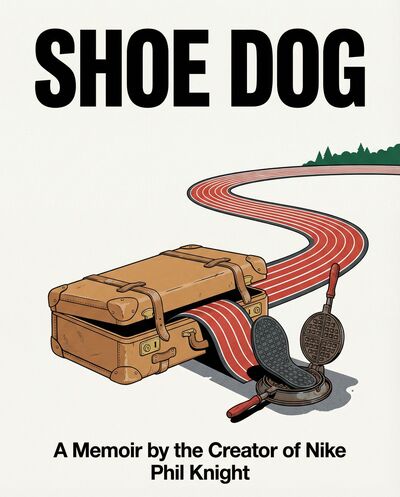
Shoe Dog: A Memoir by the Creator of Nike
by Phil Knight
Phil Knight's raw memoir reveals how Nike grew from a shy runner's crazy idea into a global empire, driven by passion over profit and a willingness to risk everything for the game.
Key Ideas
Life's goal should be to find
Life's goal should be to find a 'calling' that makes work feel like play, allowing for the stamina required to survive years of hardship.
True brand birth occurs when a
True brand birth occurs when a company stops being a middleman for others' products and begins to live or die by its own innovations and name.
A core team of unconventional thinkers
A core team of unconventional thinkers (the 'Buttfaces') who share total trust and a 'survivor' mindset can overcome any institutional obstacle.
Growth often requires 'playing the float'
Growth often requires 'playing the float' and operating on the edge of bankruptcy, necessitating creative and sometimes absurd legal and financial solutions.
A company is a network of
A company is a network of human relationships and shared sacrifices, making it impossible to separate personal life from professional mission.
Summary
Introduction
What if the world’s most famous brand didn't start in a boardroom, but as a 'Crazy Idea' in the mind of a shy runner who was terrified of becoming a salesman? Phil Knight didn't want a career; he wanted a calling that felt like play, and he was willing to go broke just to stay in the game.
1962: The Bluff at the Edge of the World
Phil Knight, at 24, stood on the edge of the Pacific with nothing but a "Crazy Idea"—that Japanese running shoes could disrupt the German-dominated market. With no money, office, or company, he asked his father for a loan to travel the world, framing it not as vacation but as a search for his destiny. When he arrived in Kobe, Japan, and walked into a meeting with Onitsuka Tiger executives, they asked who he represented. With nothing but a racing heart and desperation, he blurted out "Blue Ribbon Sports of Portland"—speaking a company into existence on the spot.
Knight's story illustrates that we often wait for permission or perfect readiness before acting, but success requires jumping before you're prepared. He shows that "the cowardly never start and the weak die along the way," leaving only those willing to be misfits who act despite uncertainty. His journey began with what was essentially a lie that he spent the next two decades making true—he wasn't just selling shoes, but selling the courage to pioneer your own path. Starting is messy and improvisational, requiring a leap of faith rather than perfect planning.
1963-1965: The Mad Scientist and the Salesman
Phil Knight started selling Tiger shoes from his car trunk at track meets, transforming from a shy introvert into a passionate believer when discussing the product. He wasn't traditional selling—he was sharing what he saw as a vital secret with fellow runners. His approach worked because he genuinely believed in the shoes' potential to improve performance.
Knight's partnership with Bill Bowerman, his former University of Oregon track coach, proved crucial to the company's innovation. Bowerman obsessively experimented with shoe design, famously using his wife's waffle iron to create a revolutionary sole pattern. He treated every shoe as an engineering problem, constantly seeking ways to reduce weight and improve performance through unconventional materials and methods.
Their success stemmed from treating their work as a mission rather than just a business. Both men shared an obsession with perfection and viewed the track as their laboratory. However, as orders increased, they faced the growing pains of expansion—highlighting how scaling a business creates new challenges even when the core mission remains strong.
1966-1970: Living on the Float
Knight's company Blue Ribbon Sports was trapped in a financial paradox during the late 1960s—sales were doubling annually and customers loved the shoes, but the bank account remained empty. Every dollar earned was immediately sent to Japan for inventory, creating what Knight called "living on the float," a dangerous cycle of perpetual debt and cash flow juggling. His bank wanted him to slow growth for financial safety, but Knight understood that in startups, slowing down meant death.
The period became a test of pure endurance rather than intelligence or strategy. Knight learned that resilience was his only real competitive advantage, as the business world was littered with those who started strong but couldn't withstand the constant pressure of near-bankruptcy and sleepless nights. This financial tightrope walk was about to become even more precarious, as Knight's Japanese suppliers began looking for exit strategies, threatening to force the company to become truly independent whether it was ready or not.
1971-1972: The Birth of the Swoosh
Phil Knight discovered that Onitsuka, his Japanese partner, was secretly seeking other U.S. distributors to replace Blue Ribbon Sports entirely. Faced with betrayal from the company he had sacrificed for, Knight chose independence over surrender. The scramble to create their own brand led to "Nike" - a name that came from employee Jeff Johnson's dream, despite Knight preferring "Dimension Six." They hired a local student for $35 to design the now-iconic Swoosh logo, which Knight admitted he didn't love but hoped would grow on him.
The early Nike team called themselves the "Buttfaces" - a brotherhood of misfit outcasts who gathered in smoke-filled rooms to argue their way to solutions. Unlike polished MBA executives, they were cynical, brilliant, and fiercely loyal survivors bound by trust forged in adversity. Knight realized that a true brand isn't just a logo, but the collective will of people who defend it - the spirit of the fight itself. With their own shoes finally in hand, they now faced a new enemy: government bureaucracy threatening to tax them out of existence.
1973-1977: Guerilla Warfare in the Marketplace
During 1973-1977, Nike faced an existential threat when the U.S. Customs Service hit them with a $25 million tax bill based on an obscure "American Selling Price" rule, largely driven by competitor lobbying. The bill would destroy the company whether they paid it or not, creating a seemingly impossible situation that tested the young company's survival instincts.
Nike responded with unconventional guerrilla tactics, turning the bureaucracy against itself. They created deliberate "knock-off" versions of their own shoes to manipulate market valuations and mess with the government's pricing formulas. This high-stakes legal gambit was risky but brilliant—refusing to be bullied by a system designed to favor established players. The company operated in constant litigation while never stopping innovation, with Bowerman continuing to tinker with designs and the sales team pushing forward despite the legal storm.
The crisis revealed Nike's core identity as Pacific Northwest rebels with pioneer grit. They treated the battle not just as a business problem but as a fight for survival, learning to thrive in chaos while staying true to their misfit nature. The lesson was clear: when conventional paths are blocked, successful companies find unconventional solutions and refuse to be crushed by unfair systems.
1978-1980: The IPO and the Transformation
In 1980, Nike went public despite Phil Knight's fears that it would destroy the company's family culture and entrepreneurial spirit. He ultimately decided to honor the employees and supporters who had sacrificed for the company during its struggling years. The IPO transformed people who had believed in Nike into millionaires—like Bob Woodell's mother, whose $7,000 investment during a cash crisis became over a million dollars.
Knight learned that business is fundamentally about spiritual connections and relationships, not just transactions. The IPO wasn't an ending but a transformation that gave Nike the resources to survive and scale globally while forcing Knight to reconsider what success meant. His key insight: business is deeply personal, and you should seek a calling rather than just a career—something that will sustain you through the hardest moments when everything is on the line.
Read the full summary of Shoe Dog: A Memoir by the Creator of Nike on InShort
Open in App